
A Journey Through Time

Truffles Through History

From ancient civilisations to the Renaissance: 5,000 years of gastronomic culture

Timeline

A journey through the millennia

3000
BC

The Sumerians and Babylonians

Some authors trace the earliest accounts of truffles back to the ancient Sumerians, who are said to have regularly eaten truffles mixed with the few crops available to them, such as barley, chickpeas, lentils and mustard.

Later, the Babylonians, who conquered them around 3000 BC, continued this custom and prized truffles so highly that plentiful baskets were supplied for the royal table.
2600
BC

The Egyptians and Pharaohs

The Egyptians were no exception (2600 BC), and Pharaoh Khufu is said to have been particularly fond of them.

2nd century
BC

The Greco-Roman Era

The Greco-Roman era witnessed a lively debate about the nature of truffles, involving philosophers, naturalists, poets and emperors.

As early as the 2nd century BC, Juvenal, at one of the banquets where he would recite his satires, mentioned truffles after describing a pork dish:

"After this, truffles will be served, if the longed-for storms have made our dinners more plentiful!"— Juvenal

Cicero was more concise, simply stating: "Truffles are children of the earth". After him Valerius Flaccus put forward an unusual theory about truffles: "Urticam mare procreat, terra vero tubera" (As the sea produces seaweed, so the earth produces truffles).

Emperor Nero, between one fire and the next, enjoyed composing poetry to the lyre and emphatically described them as:

"Truffles are children of the gods!"— Nero
476
AD

The Middle Ages: Centuries of Oblivion

In the Middle Ages their trail disappears. Truffles vanish from chronicles and tables for several centuries, shrouded in mystery and forgotten.

1500
AD

The Renaissance: The Great Return

Truffles reappear in the Renaissance, at the tables of Catherine de' Medici and Lucrezia Borgia and at all the most sumptuous banquets.

In the 1500s, the Umbrian physician Alfonso Ciccarelli wrote the first treatise on truffles. In the same century, for the first time, Andrea Cesalpino unequivocally classified truffles as fungi.

1810
AD

Discovering the Link with Plants

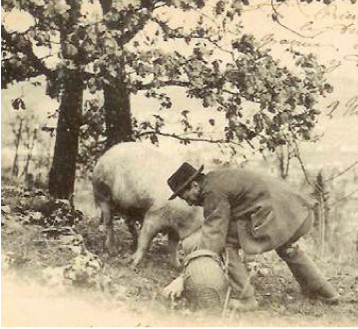
It is worth remembering that the "link" between plants and truffles was first recognised by a French farmer in 1810. After sowing acorns gathered beneath oaks that produced black truffles (of the species "Tuber melanosporum"), he noticed a few years later that the young oaks had also begun producing truffles.

1900
AD

Scientific Proof of Symbiosis

Yet more than another century had to pass before Oreste Mattirolo was able to demonstrate the mycorrhizal relationship and reveal the symbiotic connection between trees and truffles.

The Scientific Revolution

For millennia, truffles were shrouded in mystery. Philosophers, poets and emperors debated their nature without truly understanding their origin.

Only in the 19th century, thanks to a French farmer's insight and the subsequent scientific research of Oreste Mattirolo, was the secret finally revealed: mycorrhizal symbiosis between fungus and plant.

This discovery transformed our understanding of truffles, turning a "miracle of nature" into an explainable scientific phenomenon and paving the way for modern truffle cultivation.

Five thousand years of history in a single aroma

Discover the Alta Langa truffles that carry on this millennia-old tradition.